
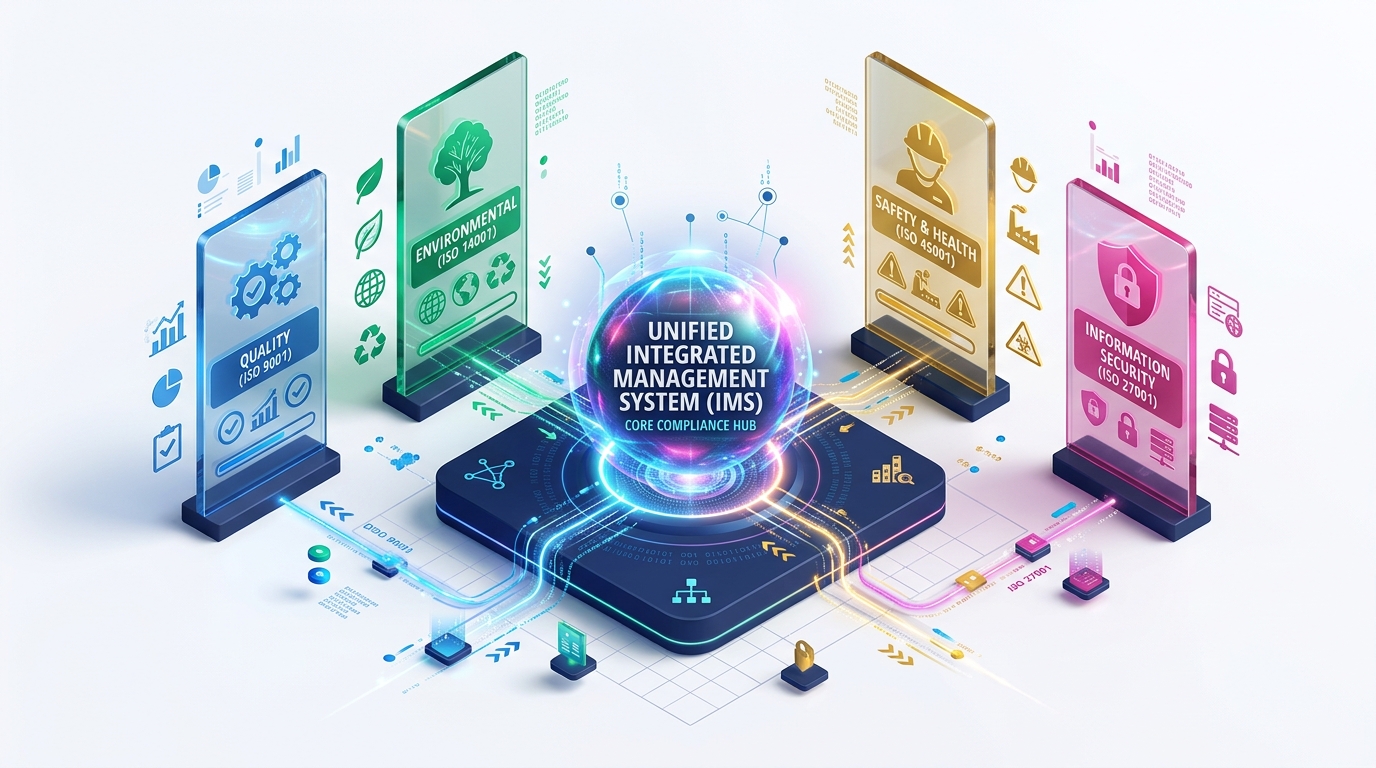
The Integrated Management System (IMS) Blueprint: Unifying ISO 9001, 14001, 45001 & 27001 in M-Files
The Multi-Standard Challenge: Why Managing Separate Folder Silos Collapses
As Australian organisations scale and bid on complex commercial contracts, they frequently discover that maintaining a single ISO certification is no longer sufficient. Tier-1 enterprise tenders, government supply chains, and major infrastructure projects routinely demand verified compliance across multiple international management standards:
- ISO 9001:2015 — Quality Management Systems (QMS)
- ISO 14001:2015 — Environmental Management Systems (EMS)
- ISO 45001:2018 — Occupational Health & Safety Management Systems (OH&SMS)
- ISO 27001:2022 — Information Security Management Systems (ISMS)
When organisations manage these standards through isolated spreadsheets, disconnected SharePoint libraries, and disparate network drives, administrative friction quickly builds. The safety team maintains one register in a shared drive, quality procedures sit in a SharePoint site, environmental logs live in another folder, and IT security policies reside in an IT repository.
Disconnected Folder Silos
- ✕ Redundant Registers: 4 separate document registers, 4 vendor logs, and 4 disjointed incident databases.
- ✕ Version Drift: Modifications in a shared procedure (e.g. contractor management) fail to update across all standards.
- ✕ Audit Fatigue: Staff endure 4 independent surveillance audits each year, repeating the same evidence requests.
- ✕ Administrative Overhead: Quality managers spend up to 40% of their working hours manually reconciling cross-departmental records.
Unified IMS Vault (M-Files)
- ✓ 1 Master Metadata Vault: A single procedure associates with ISO 9001, 14001, 45001, and 27001 simultaneously.
- ✓ Centralised CAPA Hub: Quality defects, safety incidents, environmental breaches, and cyber alerts share 1 automated workflow.
- ✓ Integrated Surveillance Audits: Coordinated audit schedules reduce external auditor days and certification fees by up to 35%.
- ✓ Continuous Audit Readiness: Full cryptographic revision histories and electronic signatures available instantly at audit time.
According to auditing standards published by the Joint Accreditation System of Australia and New Zealand (JAS-ANZ), executing combined management system audits across harmonised standards saves organisations 20% to 35% in external auditor site fees while dramatically reducing internal preparation downtime.
The Annex SL Foundation: The Shared DNA of Modern ISO Standards
The secret to building an effective Integrated Management System lies in Annex SL (the High-Level Structure / Harmonised Structure established by the International Organization for Standardization (ISO)).
All modern ISO management system standards share identical clause numbers, core definitions, and foundational governance principles:
The Annex SL Integrated Management System (IMS) Matrix in M-Files
The table below demonstrates how the core clauses align across all four standards under Annex SL:
| Standard Clause | ISO 9001 (Quality) | ISO 14001 (Environment) | ISO 45001 (OH&S) | ISO 27001 (InfoSec) |
|---|---|---|---|---|
| Clause 4 | Context of Organisation | Context & Environmental Aspects | Context & Worker Participation | Context & Threat Landscape |
| Clause 5 | Leadership & Commitment | Environmental Policy | Worker Consultation & Policy | Information Security Policy |
| Clause 6 | Objectives & Risk Planning | Environmental Aspects & Risks | Hazard Identification & Risks | ISMS Risk Assessment (SoA) |
| Clause 7 | Resources & Competence | Environmental Competence | OH&S Competence & Training | Security Awareness Training |
| Clause 7.5 | Documented Information | Documented Information | Documented Information | Documented Information |
| Clause 9.2 | Internal Audit Program | Internal Audit Program | Internal Audit Program | Internal Audit Program |
| Clause 9.3 | Management Review | Management Review | Management Review | Management Review |
| Clause 10.2 | Nonconformity & CAPA | Nonconformity & CAPA | Incident & Corrective Action | Nonconformity & CAPA |
Because these frameworks share identical governance mechanics, maintaining segregated administrative repositories creates unnecessary operational waste.
The 4 Shared Pillars of an Integrated Management System
When Range IS configures an Integrated Management System in M-Files, we establish unified workflows across all four standards:
1. Unified Policy & Document Control (Clause 7.5)
Rather than maintaining separate, duplicate procedures for general requirements like document approval, record retention, and supplier evaluation, an IMS utilises master governance workflows. In M-Files, metadata tags associate documents with relevant standards (e.g. [Quality], [Safety], [Environment], or [InfoSec]), ensuring staff always access the authorised current revision without creating multiple files.
2. Centralised Incident & CAPA Workflows (Clause 10.2)
Whether an issue relates to a product defect (ISO 9001), an environmental near miss (ISO 14001), a workplace safety hazard (ISO 45001), or a security event (ISO 27001), records are managed through structured Corrective and Preventive Action (CAPA) workflows:
- Structured incident intake and automatic notification to designated process owners.
- Documented root-cause investigation before action closure.
- Contextual linkage to related operating procedures, risk registers, and training records.
- Configurable effectiveness review checkpoints to ensure corrective measures remain sustainable.
3. Coordinated Internal Audit Scheduling (Clause 9.2)
Rather than spreading disjointed audits throughout the year, an IMS enables teams to conduct cross-functional process audits. For example, a single review of the procurement process can evaluate supplier quality standards (ISO 9001), environmental criteria (ISO 14001), contractor safety documentation (ISO 45001), and vendor data security practices (ISO 27001).
4. Consolidated Management Review Reporting (Clause 9.3)
Executive leadership gains unified visibility across operational performance. An IMS consolidates management review inputs—including customer feedback, safety metrics, environmental targets, and cybersecurity posture—into a structured reporting framework.
How M-Files Supports Multi-Standard Governance
M-Files provides a metadata-driven information architecture that adapts naturally to multi-standard compliance:
- Multi-Standard Metadata Associations: A single policy or procedure can be associated with multiple ISO clauses simultaneously, appearing in relevant compliance views without duplicating the underlying file.
- Dynamic Training Task Assignments: When a revised procedure is approved, M-Files can assign role-based reading tasks to relevant team members and track electronic acknowledgements.
- Auditable Revision History: Complete audit logs track every document creation, modification, approval, and permission change, helping quality managers quickly surface evidence during external audits.
The Operational Value for Australian Organisations
Deploying a unified Integrated Management System in M-Files delivers tangible business outcomes:
- Reduced Administrative Overhead: Consolidate master registers and eliminate duplicate data entry across departments.
- Streamlined Certification Audits: Support external auditors with rapid evidence retrieval across shared clauses.
- Stronger Governance for Tenders: Present a mature, cohesive management system across Quality, Safety, Environment, and Security when responding to enterprise and government proposals.
Ready to Unify Your ISO Compliance in M-Files?
Discover how Range IS helps Australian organisations transition from scattered spreadsheets and folders to an automated, auditable Integrated Management System.
- Explore Quality Management Software (QMS) — Learn how M-Files powers integrated compliance vaults.
- Schedule a Live QMS & IMS Demonstration — See our multi-standard ISO compliance configurations in action.
- Explore M-Files in a Free 30-Day Sandbox — Test metadata workflows, approvals, and compliance vaults firsthand.