
Automating Contract Lifecycle Management (CLM): Eliminating Missed Milestones & Costly Auto-Renewals
The Hidden Financial Leak in SME Commercial Agreements
For Australian mid-market commercial businesses, contracts are the lifeblood of revenue and vendor partnerships. Yet, according to global benchmark research conducted by the World Commerce & Contracting (WorldCC) organisation, companies lose an average of 9.2% of their annual turnover due to poor contract governance, missed operational milestones, unnegotiated evergreen auto-renewals, and uncontrolled scope creep.
In many organisations, contract management remains an ad-hoc administrative exercise. Signed PDF agreements are scanned, emailed to accounts, and subsequently filed away in departmental SharePoint folders or local desktop drives — where their obligations, indexation clauses, and expiry dates are forgotten until an emergency occurs.
Folder-Based Contract Friction
- ✕ Evergreen Lock-Ins: 30-day non-renewal notice windows lapse unnoticed, triggering unwanted 12-month auto-renewals with 8% price hikes.
- ✕ Redline Version Chaos: Conflicting Word attachments emailed across stakeholders lead to signing outdated draft clauses.
- ✕ Lost Milestone Revenue: Project teams fail to trigger contractually agreed progress billings or price review adjustments.
- ✕ Undefined Liability Caps: Sales teams sign customer agreements without legal review, inadvertently accepting uncapped consequential damages.
Metadata-Driven Contract Intelligence
- ✓ Automated Expiry Alerts: Proactive 90, 60, and 30-day notifications alert commercial managers prior to contract cancellation windows.
- ✓ Standardised Template Assembly: Pre-approved clause libraries and dynamic interview forms generate compliant agreements in minutes.
- ✓ Integrated Digital Signatures: Native integrations with DocuSign, Adobe Sign, and Hubshare eliminate printing and manual scanning.
- ✓ Obligation Tracking Dashboards: Instant executive oversight into total active contract value, upcoming renewals, and SLA liabilities.
The 4 Systemic Friction Points in the Traditional Contract Lifecycle
When organisations rely on email chains and shared folders, the contract lifecycle breaks down across four predictable stages:
1. The Authoring Bottleneck
When drafting a new Master Services Agreement (MSA), statement of work, or vendor agreement, staff frequently locate an older contract from another client, copy the file, and overwrite names. This dangerous habit frequently leaves obsolete pricing schedules, incorrect governing law jurisdictions, or irrelevant client-specific concessions embedded in the new document.
2. Chaotic Redlining and Approval Delays
Internal review cycles often resemble an administrative maze. Drafts are emailed to operations, finance, and legal counsel simultaneously. Each reviewer creates their own local copy, annotating changes in isolation. Reconciling these divergent redlines can take days, introducing friction that frustrates prospective clients and delays deal execution.
3. The Evergreen Auto-Renewal Trap
Many enterprise software, telecommunications, and equipment leasing contracts contain “evergreen” clauses: if neither party provides formal written notice of termination 60 or 90 days before expiry, the contract automatically extends for another 12 or 24 months. Without proactive calendar triggers, businesses spend tens of thousands of dollars on software seats or services they no longer use.
4. Post-Execution Obligation Amnesia
Once signed, contracts are typically filed away. Commercial milestones — such as annual Consumer Price Index (CPI) indexation reviews, volume rebate deadlines, or SLA compliance audits — are rarely captured in operational calendars, leaving substantial revenue uncollected.
The Modern CLM Architecture in M-Files
By centralising agreements within M-Files Document Management and deploying Workflow & Agentic Automation, organisations transform static PDF files into proactive business assets.
The Automated Contract Lifecycle in M-Files
4 Concrete M-Files Features That Protect Commercial Margins
1. Automated Document Assembly with M-Files Ment
Rather than starting from scratch or altering older client contracts, business users complete an interactive questionnaire powered by M-Files Ment.
Based on selected criteria (e.g. jurisdiction: New South Wales; payment terms: 14 days; liability cap: 100% of fees), M-Files Ment automatically injects pre-approved legal clauses and generates a flawless, corporate-branded contract draft in seconds. Non-legal team members can produce tailored agreements without risking non-compliant terms.
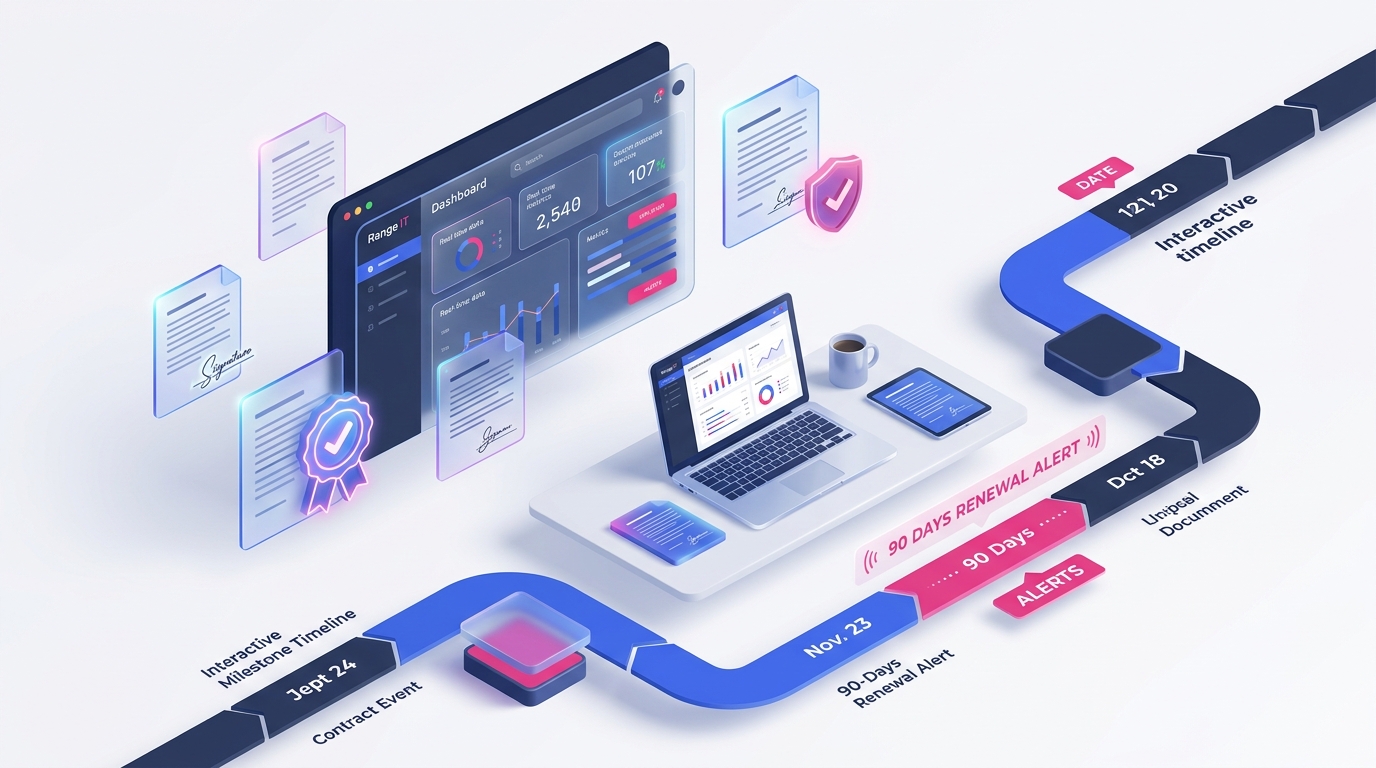
2. Proactive 90, 60, and 30-Day Expiry Cadences
Every contract object in M-Files is tagged with structured metadata:
- Contract Value (AUD)
- Effective Date & Expiration Date
- Notice Period for Termination (e.g. 60 days)
- Internal Commercial Owner
Using background scheduled rules, M-Files calculates the exact “Decision Date” (Expiry Date minus Notice Period) and issues automated task reminders to the commercial owner:
- 90 Days Prior: Review vendor performance, evaluate competitive quotes, or discuss expansion with the client.
- 60 Days Prior: Formal review meeting scheduled with management.
- 30 Days Prior: Final warning to dispatch formal notice of termination or execute a renewal addendum.
3. Integrated Electronic Signatures & Instant Vault Filing
Through native integrations with DocuSign, Adobe Acrobat Sign, and Hubshare, contracts are routed for electronic signing directly from M-Files.
Once all parties sign, the finalised, tamper-evident PDF along with the completion audit certificate is automatically retrieved and archived in M-Files. The metadata state automatically transitions from [Pending Signature] to [Active / Executed], simultaneously triggering downstream project setup or billing notifications.
4. AI-Driven Contract Analysis with M-Files Custom Agents
With M-Files Custom Agents & AI Automation, organisations can rapidly interrogate incoming vendor paper.
M-Files automatically analyses third-party agreements to surface critical commercial terms:
- Identifying uncapped indemnities or missing limitation of liability clauses.
- Extracting payment terms, warranties, and insurance obligations.
- Highlighting non-standard governing laws (e.g. foreign jurisdictions) for legal escalation.
Operational Comparison: Manual Filing vs. Automated M-Files CLM
The table below illustrates the operational efficiency achieved by replacing shared folders with metadata-driven contract management:
| Contract Management Dimension | Legacy Folder / Email Workflow | M-Files Automated CLM |
|---|---|---|
| Contract Assembly Time | 2 to 4 hours copying old Word files. | 5 to 10 minutes via guided M-Files Ment templates. |
| Approval Cycle Duration | 7 to 14 days chasing email attachments. | 24 to 48 hours via automated parallel workflows. |
| Visibility into Expiring Contracts | Zero visibility until an invoice arrives. | Real-time dashboards with automated 90/60/30-day alerts. |
| Searchability & Findability | Manual folder browsing (often failing to locate executed files). | Instant full-text and metadata search (find by client, value, or clause). |
| Regulatory & ISO Compliance | Incomplete audit logs and scattered emails. | Immutable revision histories compliant with ISO 9001 and ISO 27001. |
Accelerate Your Contract Governance with Range IS
Establishing automated contract governance does not require replacing your existing productivity suite. M-Files operates seamlessly alongside Microsoft 365, Teams, and Outlook, allowing your team to draft, review, and approve commercial agreements without changing how they work.
Range IS assists Australian businesses in establishing robust, automated contract lifecycles:
- Clause Library & Template Harmonisation: We review your standard agreements and configure dynamic templates in M-Files Ment.
- Workflow Automation: We configure automated review pathways, financial thresholds for executive sign-off, and proactive renewal alerts.
- Systems Integration: We connect contract metadata directly to your CRM, ERP, and project management platforms.
Learn how Range IS streamlines commercial operations by exploring our Document Management Solutions, reviewing our guide on Document Template Generation, or booking a contract management demonstration today.