
Cyber Insurance in 2026: Why Australian Insurers Are Denying Claims (And the 5 Technical Controls You Must Prove)
The End of “Tick-and-Flick” Cyber Insurance Policies
A few years ago, securing a comprehensive cyber insurance policy for an Australian business was relatively simple: the finance manager completed a two-page application form, ticked “Yes” to having antivirus and backups, paid the premium, and assumed the business was fully covered against cyber attacks, data breaches, and ransomware extortion.
Those days are completely over.
Following high-profile Australian breaches and a surge in sophisticated ransomware-as-a-service operations, global insurance underwriters have suffered immense loss ratios. In response, underwriters have radically tightened their criteria.
In 2026, renewal applications are 15-page technical audits, premiums have increased, and—most importantly—insurers are routinely denying claims during forensic post-incident investigations.
┌─────────────────────────────────────────────────────────────┐
│                 WHY CYBER CLAIMS GET DENIED                 │
├─────────────────────────────────────────────────────────────┤
│ 1. Policy Application states: "MFA is active on all accounts"│
│ 2. Ransomware breaches a single un-MFA'd legacy mailbox     │
│ 3. Forensic audit discovers discrepancy in technical setup  │
│ 4. RESULT: Claim denied under "Material Misrepresentation"  │
└─────────────────────────────────────────────────────────────┘
If an incident occurs and the forensic team discovers that your actual technical controls do not match what was declared on your renewal questionnaire, your insurer can legally void the policy under the Insurance Contracts Act 1984 (Cth).
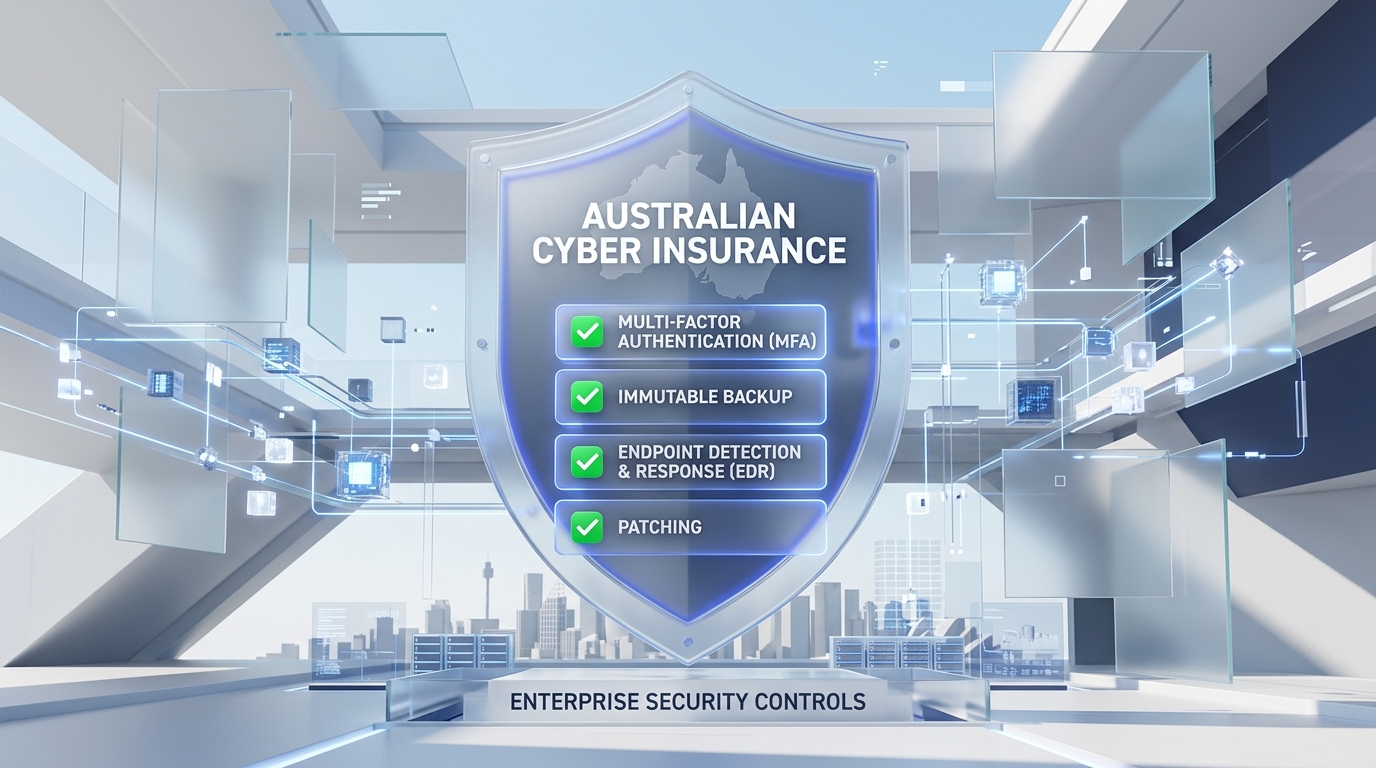
Here are the 5 mandatory technical security controls that every Australian SME must not only implement, but be able to prove with auditable logs in 2026.
The 5 Mandatory Technical Controls Australian Insurers Demand
1. Phishing-Resistant Multi-Factor Authentication (MFA) Everywhere
Insurers no longer accept “MFA on email only.” Underwriters require verified, mandatory MFA across:
- All Email & Microsoft 365 / Google Workspace accounts.
- All Remote Access & VPN connections.
- All Administrator & Privileged accounts (domain controllers, firewalls, backup appliances).
- All Third-Party & Cloud SaaS platforms storing sensitive commercial or customer data.
Furthermore, underwriters are increasingly penalising SMS-based verification in favor of Authenticator Apps with Number Matching or FIDO2 / passkey hardware keys to prevent MFA prompt-bombing attacks.
2. Immutable, Air-Gapped Cloud Backups (The 3-2-1-1-0 Rule)
Modern ransomware variants do not just encrypt file shares—they systematically seek out, corrupt, and delete online backup repositories before triggering payload encryption.
Insurers require strict proof that your backup architecture meets modern resilience standards:
- Immutable Storage: Backups written to write-once-read-many (WORM) cloud repositories that cannot be deleted or encrypted by ransomware or rogue administrators for a minimum retention window (e.g. 30–90 days).
- Air-Gapped Isolation: Backups stored in a separate, isolated identity tenant with dedicated administrative credentials.
- Routine Restoration Drills: Documented proof of quarterly point-in-time recovery tests verifying RPO (Recovery Point Objective) and RTO (Recovery Time Objective) metrics.
3. Managed Endpoint Detection & Response (EDR) with 24/7 Threat Hunting
Traditional, signature-based antivirus is considered obsolete by cyber underwriters. It cannot detect zero-day exploits, memory-only attacks, or living-off-the-land techniques where hackers use legitimate administrative tools (like PowerShell) to move laterally across your network.
Insurers mandate Managed EDR (such as Microsoft Defender for Endpoint, SentinelOne, or CrowdStrike) that monitors endpoint behavior in real time, backed by a 24/7/365 Security Operations Center (SOC) capable of isolating infected workstations within minutes.
4. Continuous Patching Cadence (ACSC Essential 8 Compliance)
Underwriters align heavily with the Australian Cyber Security Centre (ACSC) Essential 8 maturity framework. Insurers require verified proof of rapid vulnerability management:
- Critical & High-Severity Vulnerabilities: Operating systems and internet-facing applications patched within 48 hours of public exploit availability.
- Routine Workstation & Server Patching: Automated monthly patching cycles with centralized deployment logging.
- Unsupported Software Prohibition: Complete decommissioning of legacy, end-of-life operating systems (Windows Server 2012, Windows 7/8).
5. Documented & Annually Tested Incident Response Plans
If your network is compromised at 2:00 AM on a Sunday, who calls the cyber insurer? Who coordinates the legal privacy breach notifications under the OAIC Notifiable Data Breaches (NDB) Scheme? Who contacts forensic investigators?
Insurers demand that leadership maintain a documented Incident Response Plan (IRP) and Disaster Recovery Plan (DRP) that is reviewed and simulated annually through executive tabletop exercises.
Cyber Insurance Requirements Checklist
| Technical Control | What the Underwriter Asks | Acceptable Proof / Evidence |
|---|---|---|
| MFA Everywhere | “Is MFA enforced on 100% of user and admin logins without exceptions?” | Conditional Access policy exports & Microsoft Entra sign-in audit logs. |
| Immutable Backups | “Are backup repositories isolated from domain credentials and immutable?” | Immutable cloud bucket configuration & quarterly test restore certificates. |
| Managed EDR | “Is behavior-based EDR deployed across all servers, desktops, and remote laptops?” | Centralized EDR console agent status report showing 100% coverage. |
| Patch Management | “Do you patch known exploited vulnerabilities within 48 hours?” | Vulnerability scan reports and automated patch compliance telemetry. |
| Incident Response | “Do you maintain a tested Incident Response & Business Continuity plan?” | Documented IRP document & executive tabletop review sign-off log. |
How Range IT Prepares Your Business for Cyber Insurance Readiness
Completing a 15-page cyber insurance renewal questionnaire without technical expertise is dangerous. Range IT provides complete cyber readiness and compliance management:
- Underwriting Questionnaire Audit: Reviewing your policy renewal questions alongside your actual IT configurations to ensure 100% accurate, defensible declarations.
- Essential 8 Alignment: Deploying phishing-resistant MFA, automated patch management, and strict application control baselines.
- Immutable Cloud BDR: Implementing air-gapped, immutable Microsoft 365 and server backups with regular recovery testing.
- 24/7 Managed EDR & SOC: Monitoring all endpoints around the clock with rapid threat containment.
- Incident Response Planning: Assisting executive leadership with documented IRP protocols that align with OAIC and insurer guidelines.
Summary: Cyber Security Controls Are Your Real Insurance Policy
A cyber insurance policy is a financial safety net—it is not a replacement for fundamental cybersecurity hygiene. By implementing and validating the 5 mandatory technical controls today, you protect your organisation against catastrophic downtime, ensure claim approval when disaster strikes, and negotiate significantly lower insurance premiums.
- ✅ Guaranteed Payouts: Eliminate the risk of claim denial due to policy misrepresentation.
- ✅ Lower Premiums: Prove mature Essential 8 controls to secure preferred underwriting rates.
- ✅ Ransomware Immunity: Maintain immutable backups that make extortion demands irrelevant.
- ✅ Continuous Peace of Mind: Know your systems are monitored and defended around the clock.
Need help auditing your technical controls before your insurance renewal?
Read about our Cybersecurity & Compliance solutions, check our Backup & Disaster Recovery services, or Contact Range IT for a comprehensive cyber readiness review.
🔗 Related Reading: