
The Executive Guide to the ACSC Essential 8: What Australian Directors Need to Know for 2026
From the Server Room to the Boardroom: Cyber Risk as a Director’s Duty
For years, cybersecurity was treated by many Australian executives as a technical operational item delegated entirely to internal IT coordinators or local break-fix contractors. In 2026, that mindset is legally and commercially obsolete.
Under recent guidance from the Australian Institute of Company Directors (AICD) and regulatory expectations enforcing Section 180 of the Corporations Act 2001 (Duty of care and diligence), cyber resilience is firmly established as a core corporate governance responsibility. Directors and business owners can no longer plead technical ignorance when preventable breaches compromise client data or halt trading operations.
According to the latest Annual Cyber Threat Report published by the Australian Signals Directorate (ASD) / Australian Cyber Security Centre (ACSC), the average cost of a cyber incident for an Australian small business now exceeds $46,000, while medium businesses face average losses surpassing $97,000 per incident — excluding regulatory penalties and reputational damage under the Office of the Australian Information Commissioner (OAIC) Notifiable Data Breaches scheme.
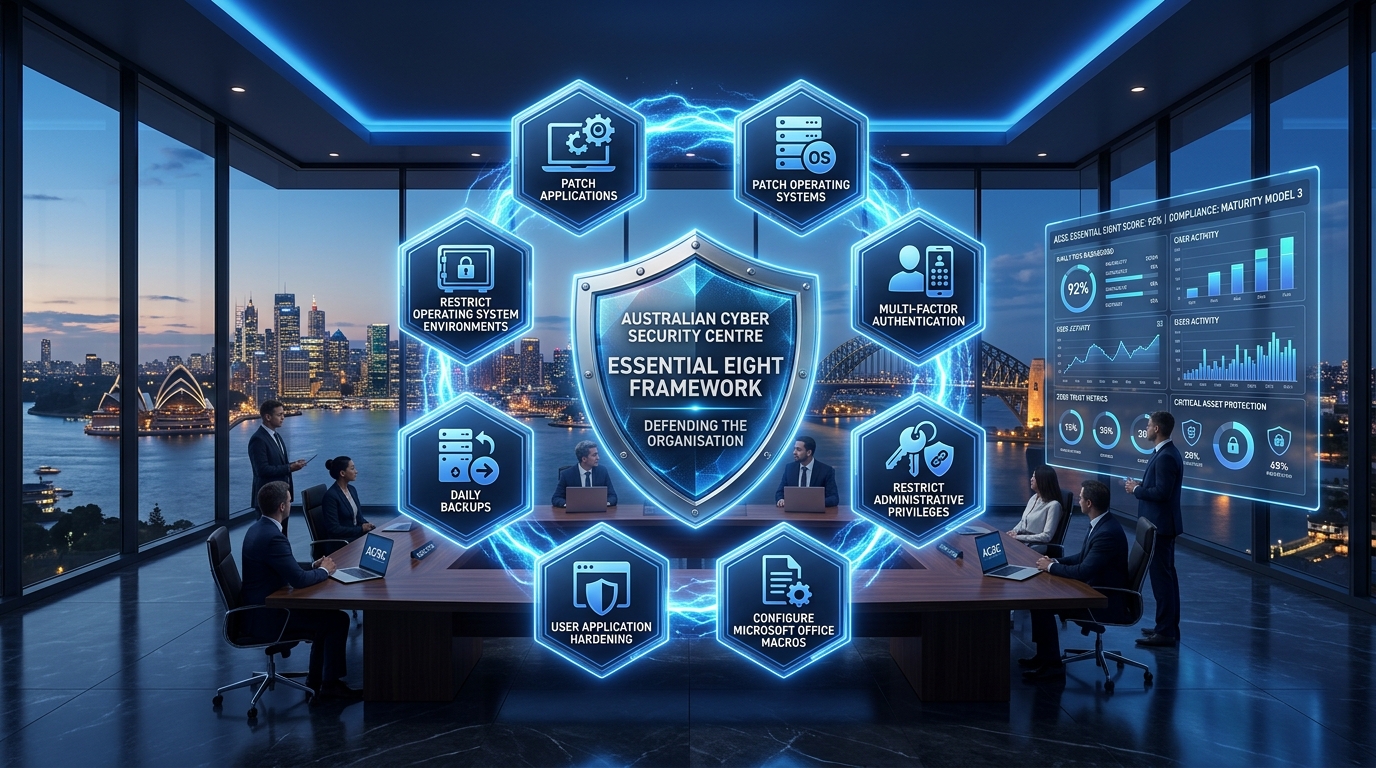
To provide Australian organisations with a clear, prioritised baseline of baseline defences, the ACSC developed the Essential Eight maturity model.
Unmitigated Cyber Exposure
- ✕ Uninsured Losses: Underwriters reject insurance claims if self-attested technical controls fail forensics scrutiny.
- ✕ Supply Chain Exclusion: Government departments and enterprise clients disqualify vendors unable to demonstrate Essential 8 Maturity Level 1 or 2.
- ✕ Ransomware Downtime: The average Australian SME ransomware attack results in 14 to 21 days of crippling business disruption.
- ✕ Personal Director Scrutiny: Regulatory investigations review board oversight and budget allocation prior to security incidents.
Managed Defence-in-Depth
- ✓ 90% Threat Neutralisation: The ACSC verifies that implementing the Essential Eight mitigates the vast majority of opportunistic attacks.
- ✓ Guaranteed Insurability: Continuous telemetry evidence satisfies strict underwriter questionnaires for rapid policy renewal.
- ✓ Tender Competitive Advantage: Proactive compliance certificates unlock lucrative Tier-1 and government procurement panels.
- ✓ Air-Gapped Recovery: Immutable 3-2-1-1-0 backups guarantee full operational restoration without paying ransoms.
Deconstructing the Essential Eight: 3 Defence Objectives
The Essential Eight is deliberately structured into three defensive objectives designed to neutralise attacks at each stage of the cyber kill chain:
The ACSC Essential Eight Operational Architecture
Understanding the 3 Maturity Levels
The ACSC defines four levels of maturity (Level 0 through Level 3). For commercial SMEs and enterprises, the relevant benchmarks are:
Maturity Level 1 (The Non-Negotiable SME Baseline)
Designed to stop opportunistic attackers using basic, automated hacking tools.
- MFA: Enforced across all remote access points (Microsoft 365, VPNs, web portals).
- Backups: Critical data is backed up daily and tested annually.
- Patching: Critical patches for internet-facing applications applied within 48 hours.
- Admins: Separate accounts for regular work and administrative duties.
Maturity Level 2 (The Recommended Standard for Mid-Market & Regulated Sectors)
Targeted at mitigating attacks from more determined adversaries who employ social engineering and credential-harvesting tools.
- Application Control: Enforced on all workstations to block unknown
.exeand.dllbinaries. - MFA: Phishing-resistant hardware or authenticator app push notifications (SMS authentication banned).
- Admin Privileges: Re-evaluated every 12 months; administrative accounts blocked from internet browsing and email.
- Backups: Immutable, unalterable cloud backups isolated from local networks.
Maturity Level 3 (The Enterprise & Critical Infrastructure Standard)
Designed to resist advanced persistent threats (APTs) and state-sponsored adversaries. Mandates comprehensive application whitelisting, cryptographic command validation, and automated network containment.
Why “Tick-and-Flick” Compliance Fails Cyber Insurance in 2026
In previous years, securing a cyber insurance policy involved a company director or broker signing a basic 2-page questionnaire confirming that “firewalls and backups are in place”.
In 2026, underwriters employ dedicated cybersecurity engineering teams who demand telemetry proof before binding coverage. As detailed in our guide on Cyber Insurance Requirements in Australia, underwriters actively inspect:
- EDR/MDR Telemetry: Proof of active 24x7 monitoring on all endpoints.
- Conditional Access Policies: Cryptographic verification that legacy protocols (POP/IMAP) are disabled in Microsoft 365.
- Backup Immutability: Technical confirmation that backup repositories cannot be deleted via compromised domain credentials.
If a company self-attests to Essential 8 compliance on an application form and subsequent forensic analysis reveals unpatched systems or missing MFA, insurers have legal grounds to deny claims under the Insurance Contracts Act 1984 for non-disclosure.
5 Questions Every Australian Director Should Ask Their IT Team Today
At your next executive or board meeting, ask these five pragmatic questions:
| Executive Question | What You Want to Hear | Red Flag Warning Sign |
|---|---|---|
1. “Can any staff member run an unapproved .exe file on their PC?” | “No, Application Control restricts software execution exclusively to verified business applications.” | “We tell staff not to download unknown files, and we have antivirus installed.” |
| 2. “Are administrative privileges completely stripped from daily accounts?” | “Yes, even IT staff use separate dedicated credentials strictly for administration.” | “A few managers and engineers have local admin rights because our software needs it.” |
| 3. “How fast do we deploy critical zero-day software patches?” | “Our automated RMM platform deploys critical patches within 48 hours of release.” | “We review updates monthly during weekend maintenance windows.” |
| 4. “If ransomware struck tonight, can the backups be deleted?” | “No, our cloud backups are air-gapped and immutable with 30-day retention lock.” | “Backups sync directly to a NAS drive located in our server room.” |
| 5. “What ACSC Essential 8 Maturity Level are we currently certified to?” | “We are actively audited at Maturity Level 1 (or 2) with continuous monitoring.” | “We haven’t assessed ourselves against the Essential Eight recently.” |
How Range IT Delivers Seamless Essential 8 Compliance
Achieving Essential Eight maturity does not require hiring an expensive enterprise internal security department.
Through our transparent Managed IT Services and Cybersecurity & Compliance Solutions, Range IT provides turnkey Essential Eight implementation for Australian SMEs:
- Rapid Baseline Audit: We execute a comprehensive technical assessment mapping your Microsoft 365 tenant, endpoints, and server infrastructure against ACSC standards.
- Continuous Patching & Application Control: Our automated management platforms deploy patches within statutory windows without disrupting staff productivity.
- Air-Gapped Cloud Backup: We deploy verified 3-2-1-1-0 immutable cloud backups for total ransomware immunity.
- Executive & Insurer Reporting: You receive regular executive dashboards and audited compliance reports ready for board presentation and cyber insurance renewals.
Protect your business, your board, and your clients. Review our transparent IT Pricing Guide, explore our Essential 8 Audit Preparation Guide, or contact Range IT to schedule a confidential cyber governance review today.