
Managing Contractor & Vendor Compliance in M-Files: Automated Licence Tracking, Insurances & Inductions
The Subcontractor Liability Trap: When Spreadsheets Fail Australian Regulators
Across Australian engineering, mining, construction, and facilities management sectors, engaging external subcontractors is a standard operational reality. However, under Australian model Work Health and Safety (WHS) laws overseen by Safe Work Australia and state regulators such as SafeWork NSW and WorkSafe Victoria, principal contractors hold a non-delegable duty of care to ensure that every individual working on their sites is fully licensed, insured, and inducted.
Despite this legal exposure, dozens of mid-market Australian enterprises continue to manage vendor compliance using disconnected Excel spreadsheets, cluttered Outlook inboxes, and shared network drives.
Unmonitored Compliance Blind Spots
- ✕ Lapsed Policies: Public liability and workers compensation certificates expire silently without automated alerts.
- ✕ Uncontrolled Site Entry: Gate security relies on printed lists that fail to reflect recent trade licence cancellations or expired inductions.
- ✕ Sub-Tier Opaqueness: Primary contractors engage secondary subcontractors whose Safe Work Method Statements (SWMS) are never sighted.
- ✕ ISO Audit Scramble: Quality and safety managers waste weeks chasing certificates across 60 vendor email threads prior to surveillance audits.
Metadata-Governed Vendor Hub
- ✓ Proactive Expiry Cadences: Automated 90, 60, 30, and 7-day email notifications trigger direct to vendors before certificates expire.
- ✓ Self-Service Vendor Portals: Subcontractors upload updated Certificates of Currency directly via secure M-Files Hubshare web workspaces.
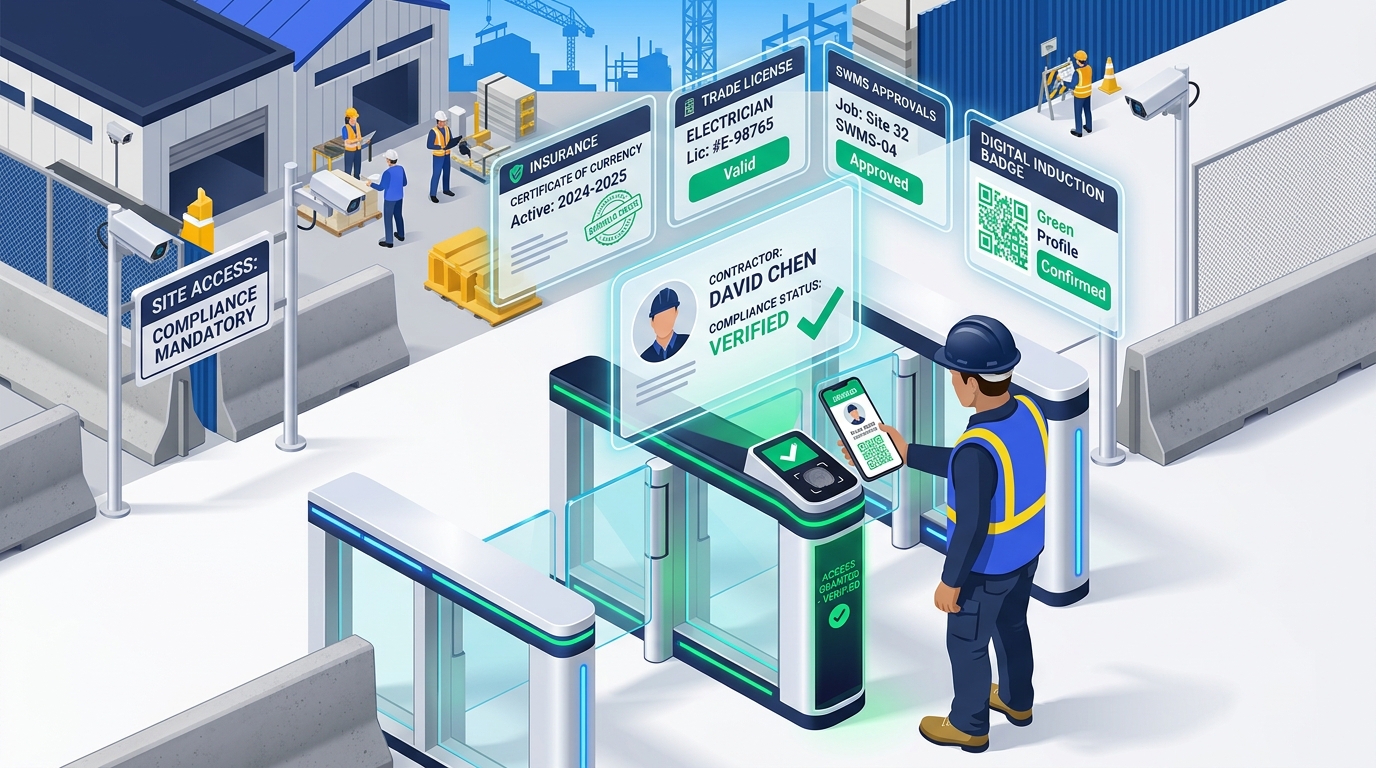
- ✓ Real-Time Gate Clearance: Dynamic compliance badges and mobile QR codes prevent gate admission if insurance or licences are invalid.
- ✓ Zero-Friction ISO Audits: Full ISO 9001 (Clause 8.4) and ISO 45001 vendor qualification logs generated in under 30 seconds.
The 4 High-Risk Failure Modes of Manual Contractor Registers
When safety or operations teams attempt to manage dozens of subcontractors via manual spreadsheets, critical compliance gaps emerge:
1. The “Ghost Certificate” Problem
A vendor submits an initial Certificate of Currency for $20M Public Liability insurance upon master contract signing. Twelve months later, the policy expires. Because no automated trigger monitors the expiry date property, the subcontractor continues working on high-risk sites completely uninsured for months until an incident occurs.
2. Trade Licence Lapses and High-Risk Work Overlooks
Specialised trades (e.g. electrical work, high-voltage cabling, dogging, scaffolding, and working at heights) require verified regulatory licences. Without systematic verification, organisations risk severe civil penalties under state WHS statutes if an unqualified contractor completes high-risk tasks.
3. Outdated Safe Work Method Statements (SWMS)
High-risk construction and industrial operations mandate task-specific SWMS. When site scopes change, subcontractors frequently operate under obsolete procedures because project supervisors lack access to the latest approved revision in the field.
4. Non-Compliance with ISO 9001 Clause 8.4 and ISO 45001 Clause 8.1.4
External ISO auditors routinely scrutinise vendor evaluation registers. Under ISO 9001:2015 Clause 8.4 (Control of externally provided processes, products and services) and ISO 45001:2018 Clause 8.1.4.2 (Contractors), organisations must systematically evaluate, select, performance-monitor, and re-evaluate external providers. A spreadsheet with missing dates and unverified attachments triggers instant major non-conformances.
The Closed-Loop Contractor Compliance Workflow in M-Files
By deploying a metadata-driven architecture in M-Files Document Management integrated with Quality Management Software (QMS), organisations automate the entire vendor compliance lifecycle:
The Automated M-Files Contractor Compliance Lifecycle
4 Practical M-Files Architectural Capabilities for Vendor Governance
When Range IS designs a contractor compliance vault, we build four purpose-configured operational mechanisms:
1. Object-Oriented Vendor Metadata Relationships
In M-Files, a contractor is not a static folder. It is an active Business Object (Vendor / Subcontractor) linked bidirectionally to:
- Child Objects: Individual workers, technicians, and site contacts.
- Compliance Documents: Public Liability ($20M minimum), Workers Compensation, Professional Indemnity, Plant Inspection Certificates, and SWMS.
- Projects & Purchase Orders: Active jobs where the contractor is engaged.
Because of this metadata architecture, updating a single insurance policy instantly updates compliance clearance across every active project in the company.
2. Multi-Stage Automated Escalation Triggers
Instead of relying on human memory, M-Files background engines execute daily status scans:
- T-90 Days: Polite automated alert to the contractor’s commercial contact requesting an updated Certificate of Currency upon renewal.
- T-30 Days: Escalated reminder with a direct upload link to their self-service Hubshare portal.
- T-7 Days: Urgent notification copied to internal procurement and the responsible site safety officer.
- T-0 Day (Expired): Automatic state transition to
[Suspended - Non-Compliant]. The contractor is highlighted in red on site dashboards, and automated email alerts notify gatekeepers.
3. QR-Code Induction & Site Access Verification
Every subcontractor employee inducted into your site procedures receives a unique digital induction card stored in M-Files. Site foremen can scan the QR code via mobile phone or tablet to verify:
- Valid site-specific induction timestamp.
- Verified trade licences (e.g. valid White Card, High Risk Work Licence).
- Active company-level insurance clearance.
If any single requirement has expired, the scanner displays an immediate visual warning, preventing unauthorised entry before work commences.
4. Seamless Integration with Accounting & ERP Platforms
Through Custom Systems Integration, M-Files integrates with ERP and financial accounting platforms like MYOB, Xero, or Microsoft Dynamics. If a contractor’s mandatory compliance documents lapse, M-Files can place an automated hold on purchase order releases or invoice approvals until documentation is updated.
Meeting ISO 9001 and ISO 45001 Audit Mandates with Zero Effort
During external audits conducted by bodies accredited by the Joint Accreditation System of Australia and New Zealand (JAS-ANZ), compliance verification is historically painful.
With M-Files, auditing vendor compliance transforms into a 30-second presentation:
| Audit Requirement | Spreadsheet Reality | M-Files Automated Solution |
|---|---|---|
| Clause 8.4 Evaluation | Disconnected emails and subjective notes in manager inboxes. | Formal annual review workflow with documented performance scoring. |
| Proof of Currency | Scanned PDFs scattered across local C: drives and folders. | Single-click filtered view showing only active, validated certificates. |
| Traceable Audit Log | Undated spreadsheet edits with zero cryptographic proof. | Immutable, uneditable event history recording user, timestamp, and action. |
| Incident Linking | Safety non-conformances logged separately from vendor files. | Direct bidirectional links between CAPA workflows and subcontractor objects. |
How Range IS Implements Vendor Governance in 30 Days
Transitioning from chaotic spreadsheets to a disciplined compliance framework does not require a disruptive multi-month software overhaul.
Range IS delivers a turnkey vendor compliance implementation:
- Audit & Register Extraction: We sanitise your existing supplier lists, extract active policy dates, and migrate records into structured M-Files metadata objects.
- Workflow & Expiry Rules Configuration: We configure your required thresholds, alert cadences, and contractor communication templates.
- Vendor Portal Deployment: Subcontractors receive secure self-service access to upload certifications without demanding internal administrative overhead.
- Site Team Training: Your safety heads, procurement teams, and site supervisors learn how to monitor compliance dashboards and execute mobile verification.
Discover how Range IS helps Australian enterprises eliminate subcontractor compliance liabilities by visiting our Quality Management Software (QMS) solution page, exploring our Integrated Management System (IMS) Blueprint, or booking a tailored demonstration with our compliance engineering team.