
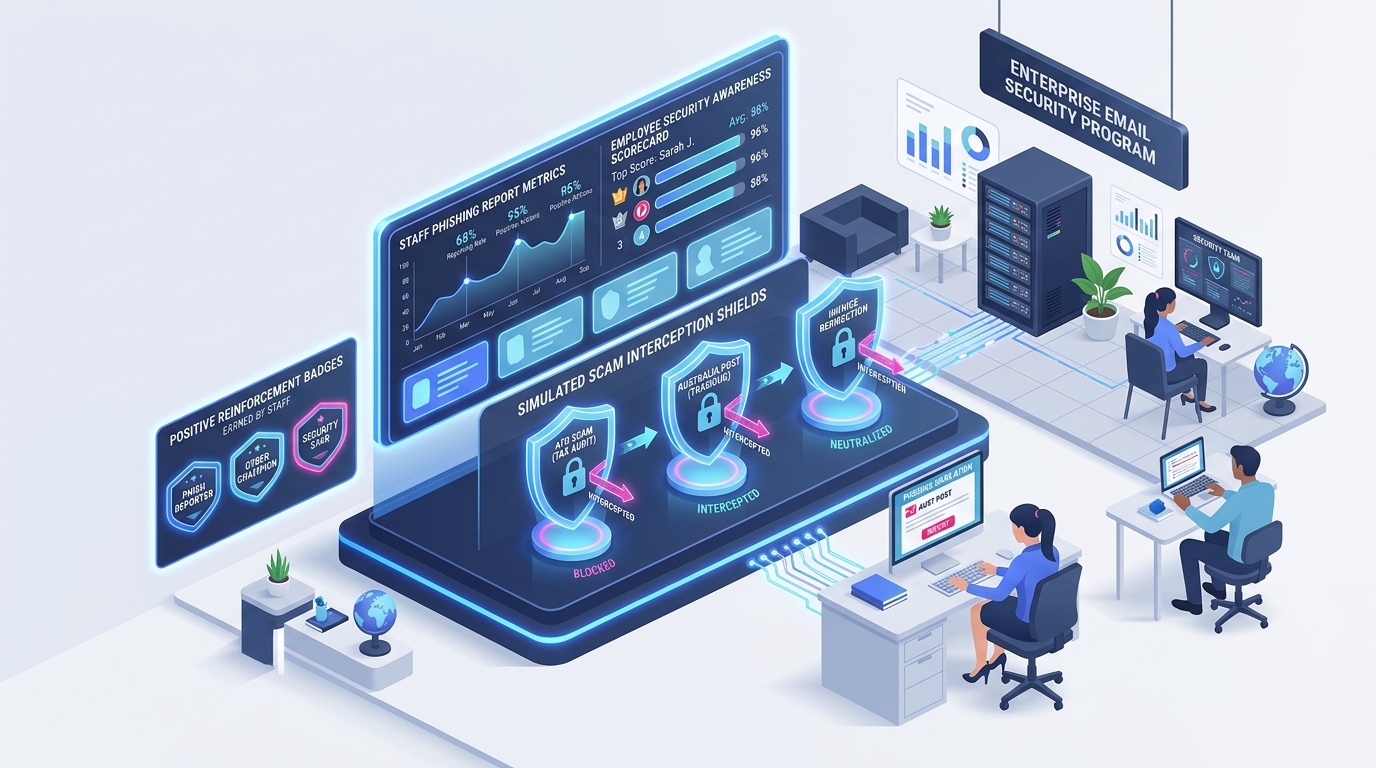
Phishing Simulations That Change Behaviour: A Practical Guide for SMEs
The Broken Status Quo: Why Traditional Phishing Tests Fail
Almost every Australian business owner or IT manager has run a phishing test at some point. The standard playbook usually looks like this: IT sends out an email pretending to be from a courier service; 22% of employees click the link; the IT department groans; leadership sends an all-staff email warning people to “be more vigilant”; and within two weeks, everyone forgets.
Three months later, an employee clicks on a real fraudulent invoice, credentials are stolen, and the business faces a costly Business Email Compromise (BEC) remediation.
Why do traditional phishing tests fail to protect organisations? Because they are designed to catch and penalise staff, rather than train and empower them.
When simulations feel like punitive “gotcha” traps set by management, they breed resentment. Staff learn to fear IT, hesitate to report suspicious emails, and—worst of all—conceal mistakes when they accidentally enter their password into a real credential-harvesting site.
Under modern cyber defence frameworks—including guidance from the Australian Signals Directorate (ASD)—effective security awareness training does not treat employees as the “weakest link”. It transforms them into an active, distributed network of first-response human sensors.
Why the “Click Rate” Is the Wrong Metric to Track
Most executive dashboards track a single number: the Click Rate (the percentage of recipients who clicked the simulated phishing link).
While reducing click rates over time is desirable, focusing exclusively on clicks creates two dangerous operational distortions:
- The Fear of Simple Tests: IT teams lower the sophistication of tests to make the click rate look artificially low for board reports, leaving staff unprepared for realistic attacks.
- Ignoring the True Protective Metric: The single most predictive indicator of an organisation’s cyber resilience is not how many people clicked—it is how quickly the first employee reported the email to IT.
The Traditional Metric: Click Rate
Merely indicates that someone fell for a trick. It tells you nothing about whether the rest of the company noticed, or whether IT was alerted in time to block the malicious domain at the firewall.
The Modern Metric: Mean Time to Report (MTTR)
Measures the minutes between a phishing email landing in inboxes and the first user reporting it via the Outlook banner. If reported within 5 minutes, IT can quarantine the email tenant-wide before colleagues open it.
Designing a Constructive, Psychology-Backed Simulation Cadence
A mature phishing program should feel like fire drills: routine, educational, and free of panic. Here is the operational cadence Range IT implements for Australian SMEs:
The Closed-Loop Phishing Simulation & Micro-Learning Cycle
1. The Baseline Assessment (No Traps, No Blame)
Before announcing any formal security scorecards, run an unannounced baseline simulation across the company. This establishes your organisation’s true starting vulnerability without staff suspecting an evaluation.
2. Realistic Australian Attack Scenarios
Generic US-centric lures (e.g. IRS tax notices, Target gift cards, or FedEx notifications) do not teach Australian employees how to spot domestic attacks. Simulations must mirror real Australian threats:
- The ATO Tax Assessment Lure: Capitalises on tax time (July–October) with claims of an uncollected refund or urgent lodgement discrepancy.
- The Australia Post / StarTrack Tracking Scam: Exploits e-commerce delivery notifications with spoofed tracking links.
- The Xero / MYOB Invoice Redirection: Claims a supplier invoice has overdue fees attached. (Connects directly to our controls in stopping invoice fraud and BEC).
- The Microsoft 365 Password Expiry: A clean lookalike login prompt warning that email access will be locked in 2 hours.
- The CEO Urgency Request: An email ostensibly from the Managing Director requesting urgent assistance with client vouchers while “stuck in a client meeting”.
3. Just-in-Time “Teachable Moments”
If an employee clicks a simulated link, never redirect them to a punitive HR page or reprimand them.
Instead, direct them to an instant, friendly 60-second learning screen that highlights:
- The exact sender address discrepancy (e.g.
ato-portal-gov.coinstead ofato.gov.au). - The artificial urgency words used in the subject line.
- The destination URL revealed by hovering over the button.
For strategies on embedding security into company culture, review our guide on building a cyber-aware culture.
Demonstrating Maturity to Boards and Cyber Insurers
Australian cyber insurance underwriters and regulatory frameworks (like the ACSC Essential Eight) increasingly scrutinise human security capabilities.
When renewing your cyber insurance policy, underwriters look for three concrete indicators of a mature security awareness program:
- Regularity: Testing conducted monthly or bi-monthly, rather than once a year.
- Dynamic Improvement: Demonstrating a measurable upward trend in the Reporting Rate over successive quarters.
- Executive Inclusion: Proving that C-suite leaders and finance directors are included in simulation lists, as executives represent the prime targets for spear-phishing.
Deploy Managed Phishing Simulations with Range IT
Building, dispatching, and tracking realistic phishing campaigns internally consumes dozens of hours that your internal team does not have.
At Range IT, our managed security service takes full ownership of your employee cyber defence training:
- Curated Australian Threat Feeds: We continuously update simulation templates to mirror active scams circulating across Australian networks.
- 1-Click Outlook Reporting Integration: We deploy native report buttons directly into your Microsoft 365 Outlook ribbon and mobile app.
- Executive Telemetry Reporting: We provide quarterly board-ready reports tracking time-to-report metrics, risk trends, and audit evidence.
Protect your organisation from credential theft and invoice fraud. Contact Range IT today to launch a tailored security awareness and simulation program for your team, or explore our full suite of Cybersecurity and Compliance services.